GET A QUOTE
GET A QUOTE
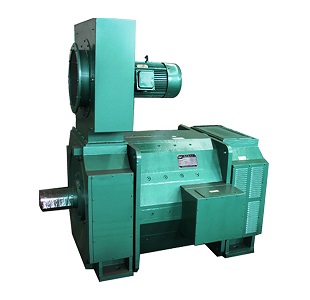
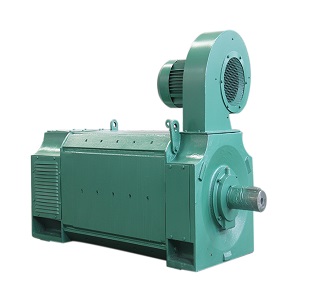
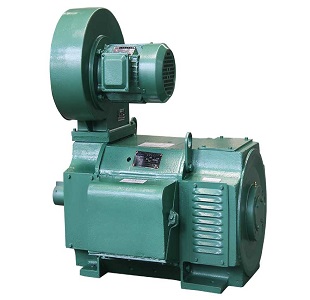
Frame sizes: 315-1000Rated output: 61-2000kWInsulation class: FDuty cycle: S1Degree of protection: IP23, IP44,IP54Excitation mode: Separate excitationVoltage: 440V, 550V, 660V, 750V
Z series medium size DC motors are newly
products of the works developed with latest technology of design and
manufacturing. There are six shaft heights for motor frames ranging from 315-560
mm.
The performance, outline dimensions and
technical specifications of the motors conform to the standard of our country
(GB) and International Electric Committee (IEC), while the mechanic dimensions
tolerance of the motors conform to the standard of International Standard
Organization (ISO).
Working conditions:
1. It is allowed to install this series
motors in the environment with worse working conditions.
However, proper cooling and protection type
should be chosen to keep the cleanness of the motors.
2. The cooling air should not contain acid
or alkali material, which is harmful to the insulation and commutating
performance of the motors.
3. In case the motors will be applied to
marines, tropical and humid areas, or the areas with salt and humid air, please
notify before signing contracts.
4. The motors can reach its rated power
under the working condition of less than 1 OOOM sea level height and 40℃
ambient temperature.
5. The power source for the motors can be
provided by static rectified source or DC generator.
6.
In case the motor is powered by static rectified source, the number of
pulse wave should not be less than 6, the peak ripple wave factor not be over
10% under the rated
speed, voltage and load current.
Type description:
As the frame is of angular thin steel
laminations structure, the motor is small in volume, light in weight and can be
powered by silicon controlled rectified source. Meanwhile it has good
commutating performance in case sudden change of load current occurs.
Insulation treatment of VPI applied on the integral stator and rotor makes the
windings good in anti-humidity performance, mechanical strength and insulation
thermal conductivity. The armature core made up with silicon steel laminations
has good magnetic conductivity. Rolling bearings with operating oiling
construction are adopted. The motor insulation is class F.
The mounting of the motors conform to
Symbols for Types of Construction and Mounting Arrangements of Rotating
Electrical Machinery' specified in GB 997 and IEC 34-7.
Bracket bearing, foot mounting with one
cylindrical shaft extension
Bracket bearing, foot mounting with two
cylindrical shaft extensions
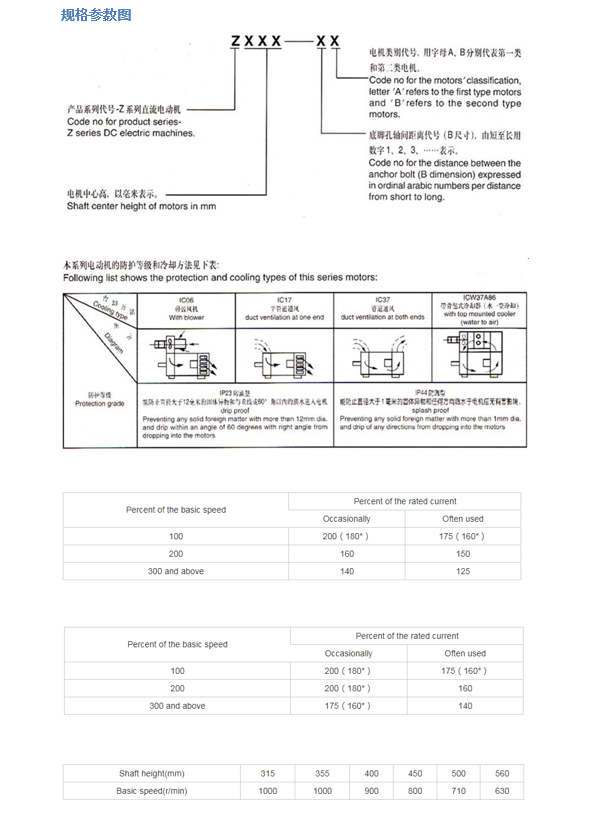
IP 23 and IP 44 is adopted for the motors'
protection of this series, which conform to the standard of "Classification
of Degrees of Protection Provided by Enclosures for Rotating Machines'
specified in GB 4942 and IEC B4-5.ICO8, ICI 7, ICB7 and ICW 37A86 is adopted
for the cooling of this series motors, which conform to the standard of Methods
of Cooling Rotating Machinery' specified in GB 199S and IEC S4-6. Other types
of protection and cooling required by customers can be negotiated. The standard
cooling air outlet locates on the side of driving end, (non commutator end).
Products performance:
1.
Continuous working system (S1) is applied.
2. The standard rated voltage of this
series motors are 220V, 380Vt 440Vt 550V and 660V. The voltage beyond above
scope can be negotiated when placing orders.
3. Separate excitation is the basic
excitation type of this series motors. Four terminals of the excitation winding
are divided into two groups. In case the two groups are in series or parallel
connection. the excitation voltage is 220V or 100V respectively. Excitation
voltage beyond the scope can be negotiated.
Forced excitation is allowed with the
voltage of less than 500V. During forced excitation I the transient excitation
current can exceed the rated excitation current slightly until the excitation
current gets stabilized.
4. Short time over-load capability:
The DC motors (class A) can sustain the
short time (1 min) overload specified in the following list:
The DC motors (class B) can sustain the
short time (1 min) overload specified in the following list:
The data in brackets are applied in case
the basic speed of the motors is equal to or greater than the speed specified
in the following list:
The occasionally used short time overload
capability refers to the motors' capability of sustaining continuous overload
within 1 minute in emergent or unusual cases The transient switching device of
breaker is suggested to be rectified according to such capability.
The often used short time over-load
capability as a part of normal operating period refers to the motors'
capability of sustaining overload repeatedly.
After short time overload operation. Light
load operation is necessary to restrict the load root-mean-square of the whole
load period within its continuous rating.
The DC motors (Class B) can sustain
following continuous load:
(1) Under the rated armature voltage and
rated speed the motor can be continuously operated with 115% overload. In
this case, temperature rise will be relatively higher, and the other
performance may be different from those under specified ratings.
(2) Soon after continuous operation under
rated armature voltage and rated speed. the motor can be operated with 125% overload for
two hours. In this case, temperature rise will not exceed the specified value,
while the other performance may be different from those under specified
ratings.
Under lower overload, longer time overload
is allowed. For the motors (class B). the occasionally used overload times is
2.5 times (under the rated speed) within 15 sec. (please consult with the
manufacturer in detail)
5. Speed adjustment.
No speed adjustment is specified for this
series motors. Any special requirements in this field by customers can be
discussed.
6. Current variation:
The allowable current variation (di/dt) of
this series motors under all speeds and loads is 200 times of the rated current
per second.
7. Noise and vibration:
The noise level of this series motors
conform to the specifications stipulated in ‘Noise measuring Method for
Electric Machines of GB2806 and Standard of Noise Level for Electric Machines'
of IEC34-9.
Vibration of this series motors conform to
the specifications stipulated in vibration Measuring Method for Electric
Machines of GB2807 and Vibration Measuring Method and Limit for Electric
Machines of IEC34-14.
Capacity choosing:
Class A: DC motors
Please refer to the technical data list, Customers
can choose motor type and specifications according to the required capacity,
rotating speed, voltage and etc.
Class B: DC motors
Except the rated output of the motors,
which is lower than that of class A motors with same shaft height and foot axial
length, the other technical data are basically the same as those of class A
motors. Should the specification of class B motor be given, one can use the
specification list for class A motors to choose the preliminary type of class
B. First of all, the rated power of class B motor shall be enlarged by 25%,
according to which a corresponding type and specification can be selected out
from the specification list for class A. The "A” in the symbol of the
selected type,
However, shall be replaced with
"B" and the capacity shall be replaced with the non-enlarged power
(that means with the original capacity of the class B). Final specifications
and data can be discussed between customers and manufacturer.
For example:
Motor required by customer:
Class B motor of 96kW 220V 185r/min
Power enlarged by 25%:
120kW 220V 185r/min
Corresponding type in the specification
list for class A:
Z450-2A (118kW 220V 179r/min)
Type transformed from class A to class B:
Z450-2B (approximate 96kW 220V 185r/min)
The motor of this type can basically meet
the customer’s requirements.
Output-speed conversion (for motors of
class A):
Except the five voltages and corresponding
outputs and speeds specified in the technical data list, the other voltage
grades and their corresponding outputs and speeds can be derived from motors of
any specifications. (However, it is not allowed to exceed the allowable maximum
voltage of such specification).